
Manuscript Glossary
Discover the language of biblical manuscripts through clear, approachable definitions designed to help readers better understand the fascinating world of Scripture's transmission.
Most Common Terms
New to manuscript studies? Start with these frequently encountered terms.
Biblical manuscript studies come with plenty of unfamiliar words. This glossary is a growing resource to help you understand the terms, manuscript types, and scholarly concepts you'll encounter throughout Sacred Text Replicas — no background in the field required. For the fuller story of how these texts reached us, see From Papyrus to Modern Bibles.
The word “Bible” comes from the Greek biblia, meaning “books” — a reminder that Scripture reached us as a collection of many individual writings, not a single volume.
Knowing these terms helps a product description mean more — the difference between a fragment and a full codex, or a papyrus and a parchment copy, changes what you're actually holding.
A
Aland Number
A standard cataloguing number used to identify Greek New Testament manuscripts.
A reference number assigned to Greek New Testament manuscripts as part of a numbering system initially created by Casper Rene Gregory in 1908 and later developed by the scholar Kurt Aland, used by textual critics worldwide to identify and cite specific manuscripts consistently and effectively.
For example, the earliest known New Testament fragment is catalogued as “P52” (Papyrus 52) in this system.
Alexandrian Text
An early text-type or "family" generally associated with Alexandria, Egypt, and known for preserving the earliest reliable, ancient readings.
The Alexandrian text-type is represented by some of the earliest surviving New Testament manuscripts, primarily dating from the 2nd to the 4th centuries and preserved largely because of Egypt's dry climate. It is characterized by a concise style, often using fewer words and less polished grammar, which many scholars view as evidence of careful and faithful transmission rather than editorial smoothing. Due to the quality and antiquity of its manuscripts, the Alexandrian tradition plays a central role in modern textual criticism and is relied upon heavily in reconstructing the earliest attainable text of the New Testament. Its most important witnesses include Codex Vaticanus, a 4th-century uncial preserved in the Vatican Library, and Codex Sinaiticus, a 4th-century manuscript discovered at Saint Catherine's Monastery that contains the oldest complete New Testament.
Apparatus
An apparatus is a collection of scholarly notes that accompanies a text, providing information such as textual variants, sources, or explanatory comments.
A critical tool found in modern editions of the Greek New Testament that records significant differences among manuscripts. It lists variant readings and identifies which manuscripts support each reading, allowing readers to compare the evidence and better understand how the biblical text has been transmitted through history.
Archetype
The earliest recoverable ancestor from which all surviving copies of a group of manuscripts ultimately descend.
In textual criticism, an archetype is the hypothetical manuscript that stands at the head of a manuscript family or tradition. Although the original manuscript (the autograph) is usually lost, scholars compare surviving copies to reconstruct the archetype as closely as possible, helping trace how the text was transmitted over time.
Assimilation
A scribal tendency to alter wording to match a familiar parallel or nearby passage.
Assimilation occurs when a scribe intentionally or unintentionally alters a text so that it agrees more closely with another passage. This often happens in parallel accounts, such as the Gospels, where similar wording is harmonized to reduce differences between manuscripts.
B
Biblical Hebrew
The ancient Hebrew language of most of the Old Testament.
Biblical Hebrew was the primary language of the Old Testament, with the exception of a few passages written in Aramaic. It was spoken and written in ancient Israel from roughly the 10th to the 2nd centuries BC and is the language preserved in manuscripts such as the Dead Sea Scrolls and the Masoretic Text.
Bifolium
A bifolium is a single sheet of writing material folded in half to create two leaves (four pages).
A bifolium consists of one sheet of papyrus, parchment, or paper folded once, producing two leaves and four writing surfaces. Bifolia were the basic building blocks of early codices, the book format that largely replaced scrolls among Christians. Multiple bifolia were nested together and sewn into gatherings, allowing early biblical manuscripts to be organized into durable, multi-page books that were easier to read, carry, and reference.
Bodmer Papyri
A collection of early biblical and Christian manuscripts discovered in Egypt, dating primarily from the 2nd to the 4th centuries AD.
The Bodmer Papyri contain some of the earliest surviving copies of the New Testament, including important manuscripts such as 𝔓66 (John) and 𝔓75 (Luke and John). Their early date and excellent preservation make them invaluable for studying the transmission of the New Testament text and the development of the early Christian codex.
Byzantine Text
The largest family or text type of Greek New Testament manuscripts, becoming the dominant textual tradition throughout the Byzantine Empire.
The Byzantine Text is represented by the majority of surviving Greek New Testament manuscripts, most of which date from the 9th century onward. Although most Byzantine manuscripts date from the 9th century onward, they make up approximately 80–90% of all surviving (est. 5,000) Greek New Testament manuscripts, making the Byzantine Text the most widely preserved textual tradition. It became the standard text of the Eastern Church and served as the basis for the Textus Receptus, which was used to produce influential translations such as the King James Version.
C
CBGM
CBGM (Coherence-Based Genealogical Method) is a computer-assisted method of textual criticism used to evaluate relationships among New Testament manuscripts.
Developed by the Institute for New Testament Textual Research (INTF), the CBGM analyzes patterns of agreement and disagreement across thousands of manuscripts rather than relying solely on traditional manuscript families. By identifying which readings best explain the origin of others and how manuscripts are related, the CBGM helps scholars reconstruct the earliest attainable text of the New Testament. It has played a significant role in recent editions of the Nestle-Aland Novum Testamentum Graece (NA28) and the United Bible Societies' Greek New Testament (UBS5).
Caesarean Text
The Caesarean Text is a proposed New Testament text-type with roots in the eastern Mediterranean, especially represented in the Gospels.
A proposed text-type, chiefly in the Gospels. Although represented by manuscripts such as Family 1, Family 13, and Codex Θ, many scholars debate whether the Caesarean Text constitutes a distinct text-type or simply reflects a mixture of Alexandrian and Byzantine readings. Its classification remains one of the more debated questions in New Testament textual criticism.
Cairo Genizah
A collection of over 300,000 Jewish manuscript fragments preserved in a synagogue storeroom in Old Cairo, Egypt.
Discovered in the late 19th century, the Cairo Genizah contains biblical manuscripts, ancient translations, liturgical texts, and everyday documents dating from the 9th to the 19th centuries. Its biblical fragments provide valuable evidence for the transmission of the Hebrew Bible and Jewish textual traditions.
Catena
A chain of quotations from early Christian commentators arranged alongside a biblical text.
A A common feature of Byzantine-era manuscripts and an important early form of biblical commentary. Catenae preserve the writings of many early Church Fathers, including works that are now partially or completely lost. They are valuable for studying the history of biblical interpretation and can also provide evidence for the text of Scripture used by early Christians.
Chester Beatty Papyri
An early collection of biblical papyri assembled in the 1930s.
A group of early biblical papyri acquired by collector Alfred Chester Beatty in the 1930s, originally discovered in Egypt, includes some of the oldest substantial portions of the New Testament and Septuagint known to survive. The Chester Beatty Papyri contain important portions of both the Old and New Testaments, including manuscripts such as 𝔓45, 𝔓46, and 𝔓47. Their early date and exceptional textual value make them among the most important witnesses for studying the transmission of the biblical text.
Codex
A manuscript bound like a modern book, with pages rather than a single continuous roll.
A codex (plural: codices) is a manuscript bound along one edge with individual leaves, much like a modern book. Early Christians were among the first to widely adopt the codex format instead of the scroll, which is part of why so many New Testament fragments survive as codex pages. Nearly all major biblical manuscripts including Codex Vaticanus, Codex Sinaiticus, and Codex Alexandrinus were produced in this book form.
Codex Sinaiticus
A 4th-century Greek biblical codex containing the oldest complete New Testament and much of the Old Testament.
Discovered at St. Catherine's Monastery in the Sinai Peninsula by Constantine von Tischendorf in the 19th century. It's one of the oldest surviving complete copies of the Greek New Testament and remains central to modern textual scholarship. Along with Codex Vaticanus, it provides crucial evidence for reconstructing the earliest attainable text of the New Testament and remains one of the most significant biblical manuscripts ever discovered.
Codex Vaticanus
A 4th-century Greek biblical codex regarded as one of the most reliable and important witnesses to the biblical text.
Another 4th-century Greek Bible manuscript, held in the Vatican Library, is prized by scholars for its careful, conservative copying style. Along with Codex Sinaiticus, it's one of the two most important early witnesses to the Greek New Testament text.
Colophon
A colophon is a note written by a scribe, usually at the end of a manuscript, providing information about its production or copying.
Colophons often record the name of the scribe, the date and place of copying, or a request for prayers. They provide valuable historical evidence about the production, transmission, and use of biblical manuscripts, offering insights beyond the biblical text itself.
Conjectural Emendation
A scholar's proposed correction where no manuscript preserves a plausible reading.
Conjectural emendation is the practice of proposing a correction to a biblical text without direct support from any surviving manuscript. Scholars use conjectural emendation only in rare cases where every known manuscript appears to preserve a corrupted reading. Because it is based on informed judgment rather than manuscript evidence, conjectural emendation is generally considered a last resort in textual criticism.
Coptic
The latest stage of the ancient Egyptian language, written with a Greek-based alphabet.
Beginning in the 2nd century AD, the Bible was translated into several Coptic dialects, including Sahidic and Bohairic. Used by early Egyptian Christians for biblical translations and other texts. These early translations are important witnesses to the New Testament text and help scholars evaluate how Scripture was transmitted in the early Church.
Critical Apparatus
A critical apparatus is a collection of textual notes in a critical edition that records significant manuscript variants and the evidence supporting each reading.
Found at the bottom of the page in editions such as the Nestle-Aland Greek New Testament, the critical apparatus identifies where manuscripts differ and indicates which witnesses support each variant. It enables scholars, translators, and students to evaluate the manuscript evidence and reconstruct the earliest attainable text of Scripture.
Critical Edition
A published scholarly text with an apparatus documenting manuscript variation.
A scholarly published text that reconstructs the most likely original wording of a work, accompanied by an apparatus documenting how the manuscripts vary.
Cursive
A flowing style of handwriting in which letters are joined together.
Beginning around the 9th century AD, cursive writing became common in Greek biblical manuscripts, especially minuscules. Its faster, more compact style made copying manuscripts more efficient and eventually replaced the earlier uncial script for most biblical texts.
D
Dead Sea Scrolls
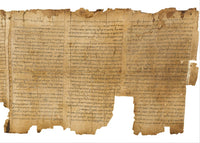
A collection of ancient Jewish manuscripts discovered near Qumran, including the oldest known copies of most Old Testament books.
A collection of roughly 900 Jewish manuscripts discovered in caves near Qumran discovered between 1947 and 1956 in caves near the Dead Sea, the collection includes the oldest surviving copies of nearly every book of the Old Testament, along with sectarian writings and other Jewish texts. The Dead Sea Scrolls have transformed the study of the Hebrew Bible by providing direct evidence for its transmission more than a thousand years earlier than the medieval Masoretic manuscripts.. Our 4Q120 replica comes from this collection.
Pictured: the Temple Scroll (11Q20), one of the longest and best-preserved of the Dead Sea Scrolls.
Dittography
A copying error where a letter, word, or phrase is accidentally written twice.
Dittography typically occurs when a scribe's eye returns to an earlier point in the text, causing unintended repetition during copying. By identifying these accidental duplications, textual critics can better evaluate manuscript relationships and reconstruct the earliest attainable text.
E
Eclectic Text
A reconstructed biblical text that selects the reading judged most likely to be original from all available manuscript evidence.
A reconstructed text built by choosing, verse by verse, whichever reading is judged most likely original among all surviving manuscripts, rather than simply following any single manuscript throughout. Modern critical editions, such as the Nestle-Aland Greek New Testament (NA28), are based on this method of textual criticism.
Exemplar
The manuscript a scribe copied directly from.
Every handwritten copy was produced from an exemplar, making these source manuscripts essential to the transmission of the biblical text. By comparing surviving copies, textual critics can identify shared exemplars and trace the relationships between manuscripts over time.
F
Facsimile / Replica
A faithful high quality reproduction of an original manuscript's text, script, and material.
The reproduction consists of an original manuscript's text, script, and material. When we use either term on this site, we mean the same thing: a handmade copy, not an antiquity. Facsimiles allow students, scholars, churches, and collectors to study and experience biblical manuscripts without handling the fragile originals. High-quality reproductions preserve details such as the script, layout, color, and damage, making these important historical documents more accessible for education and display.
Folio
A single leaf of a manuscript, with a page on each side. Front (recto) and the back (verso).
Folios are the standard way manuscripts are organized and referenced, with each leaf numbered rather than each page. This system allows scholars to accurately identify and cite specific locations within biblical manuscripts, such as folio 12r (recto) or folio 12v (verso). Manuscript folios are traditionally numbered to track a text's sequence.
H
Haplography
A scribal error in which a letter, word, phrase, or line is accidentally omitted during copying.
Haplography often occurs when a scribe's eye skips from one similar word or ending to another, unintentionally leaving out the intervening text. Recognizing these omissions helps textual critics identify copying errors and reconstruct the earliest attainable text of Scripture.
Harmonization
The process by which a scribe alters a passage to make it agree more closely with a parallel or similar passage.
Harmonization commonly occurs in the Gospels, where scribes sometimes adjusted wording to reduce differences between parallel accounts. Identifying these changes helps textual critics distinguish later scribal revisions from earlier forms of the biblical text.
Homoeoarcton
A scribal error in which text is accidentally omitted because two lines or words begin with the same or similar letters.
A copying error similar to homoeoteleuton, but triggered by two words or lines that begin with the same letters rather than end the same way. Homoeoarcton occurs when a scribe's eye skips from one similar beginning to another, causing the intervening text to be unintentionally omitted.
Homoeoteleuton
A skipped line of text caused by two similar word endings.
Homoeoteleuton occurs when a scribe's eye skips from one similar ending to another, causing the intervening text to be unintentionally omitted. It is one of the most common copying errors in biblical manuscripts and is an important consideration in textual criticism.
I
Imperial Aramaic
The Persian Empire's administrative language, used in parts of Daniel and Ezra.
The official administrative language of the Persian Empire, and the language of a few later portions of the Old Testament, such as parts of Daniel and Ezra.
Initial Text
The earliest reconstructable form of a text.
The earliest form of a text that can be reconstructed from the surviving manuscript tradition — a concept central to the Coherence-Based Genealogical Method (CBGM).
K
Koine Greek
The common, everyday form of Greek the New Testament was originally written in.
The common, everyday form of Greek spoken across the Mediterranean world in the centuries around Christ's life — the language the New Testament was originally written in, distinct from the more literary Greek of classical authors.
L
Lacuna
A gap in a manuscript where the original text has been lost.
A gap in a manuscript where text has been lost, whether through physical damage, decay, or a missing page. Scholars must judge, from context and parallel witnesses, what likely once filled the gap.
Lacunose
Describing a manuscript with many gaps in its surviving text.
A term describing a manuscript that is worn, torn, or faded to the point that portions of its text are missing — that is, a manuscript full of lacunae.
Latin
The language of the western Roman Empire and the Vulgate Bible.
The language of the western Roman Empire and, through Jerome's Vulgate, the dominant biblical language of the Western church for over a millennium.
Lectio Brevior
The principle that the shorter reading is often preferred.
A companion principle to lectio difficilior holding that, all else being equal, the shorter reading is often preferred, since scribes were more likely to add explanatory material than to remove it.
Lectio Difficilior
The principle that the more difficult reading is often the original one.
A guiding principle in textual criticism holding that, all else being equal, the more difficult or unusual reading is more likely original, since scribes tended to smooth over hard readings rather than invent them.
Lectionary
A manuscript that arranges Scripture readings by the church calendar rather than book order.
A manuscript that organizes Scripture readings according to the church calendar for use in worship, rather than presenting a biblical book in its ordinary sequence. Lectionaries give scholars an additional, independent line of evidence for how a passage was copied and read over time.
M
Majuscule
A formal style of handwriting using capital-like letters.
A formal style of handwriting composed entirely of capital-like letters of even height, of which uncial script is the best-known biblical example.
Manuscript Fragment
A surviving piece of a larger original document.
A surviving piece of a larger original document. Most ancient manuscripts we work from are fragments rather than complete texts, since papyrus and parchment degrade over centuries.
Marginalia
Notes and comments written in the margins of a manuscript.
Notes, comments, or corrections added by scribes or later readers in the margins of a manuscript, sometimes preserving valuable alternate readings or historical commentary.
Masoretic Text
The standardized Hebrew text of the Old Testament, preserved by scribes called the Masoretes.
The standardized Hebrew text of the Old Testament, carefully preserved and passed down by scribes known as the Masoretes between roughly the 7th and 10th centuries AD. It remains the primary Hebrew text used for translation today.
Minuscule
A faster, more compact lowercase style of Greek handwriting that became common from the 9th century onward.
A faster, more compact lowercase style of Greek handwriting that became common from the 9th century onward, eventually replacing the earlier uncial script for most manuscript copying. Most surviving Greek New Testament manuscripts are written in this style.
N
Nag Hammadi Library
A collection of mostly Gnostic texts discovered in Egypt in 1945.
A collection of mostly Gnostic texts in Coptic discovered in Egypt in 1945, offering scholars insight into early Christian movements outside the developing biblical canon.
Nomina Sacra
A scribal practice of abbreviating sacred names in early Christian manuscripts.
Literally “sacred names” — a scribal practice found in early Christian manuscripts of abbreviating sacred words (like God, Jesus, Christ, and Lord) using just their first and last letters, marked with a line above the abbreviation.
O
Oxyrhynchus Papyri
A vast cache of Greek papyri discovered at ancient Oxyrhynchus, Egypt.
A vast cache of Greek papyri discovered at the ancient Egyptian rubbish mounds of Oxyrhynchus, including numerous early New Testament fragments alongside everyday documents and literary texts.
P
Palaeography
The study of ancient handwriting styles, used to estimate a manuscript's date.
The study of ancient handwriting styles, used by scholars to estimate a manuscript's approximate date based on how the letters were formed.
Palimpsest
A manuscript whose original text was scraped off so the material could be reused.
A manuscript whose original text was scraped or washed off so the material could be reused for new writing, though the earlier text can sometimes still be recovered today with modern imaging techniques.
Papyrus
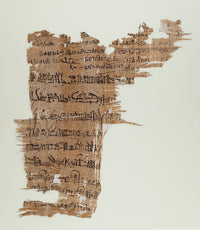
A paper-like writing material made from the papyrus plant, widely used in the ancient Mediterranean.
A paper-like writing material made from the papyrus plant, widely used in the ancient Mediterranean world. Many of our New Testament replicas are reproduced on papyrus-style material to match the original.
Pictured: a Hieratic papyrus fragment from New Kingdom Egypt, public domain, The Metropolitan Museum of Art.
Papyrus 52
A small fragment of John's Gospel, widely considered the earliest surviving New Testament manuscript.
A small fragment of the Gospel of John, widely dated to around 125 AD and considered by many scholars to be the earliest surviving physical witness to any part of the New Testament text.
Parchment
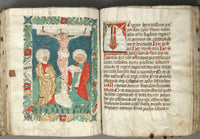
A durable writing material made from treated animal skin.
A writing material made from treated animal skin, more durable than papyrus and commonly used for Hebrew Scripture manuscripts like the Nash Papyrus (despite its name, the Nash Papyrus is actually written on parchment-like material).
Pictured: a 15th-century German Missal, tempera and ink on parchment, bound as a codex — public domain, The Metropolitan Museum of Art.
Peshitta
The standard Syriac translation of the Bible.
The standard translation of the Bible into Syriac, used historically and today by churches of the Syriac Christian tradition.
Provenance
A manuscript's documented history and origin.
A manuscript's documented history and origin — where and when it was found, and how it has been preserved since. We research provenance as part of our process before producing any replica.
Q
Quire
A small booklet of nested, folded sheets bound together with others to form a codex.
A small gathering of folded, nested bifolia sewn together at the spine; a codex is assembled by binding a series of quires in sequence.
R
Reconstruction
Proposing the likely original wording where evidence is damaged or missing.
The scholarly process of proposing the most likely original wording of a text at points where the manuscript evidence is damaged, missing, or disputed.
Recto / Verso
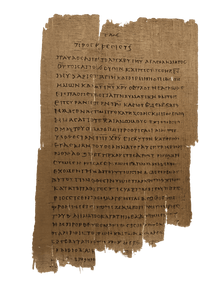
The front (recto) and back (verso) of a manuscript page.
The front (recto) and back (verso) of a manuscript page. Many papyrus fragments have writing on both sides, and we note which side a replica reproduces where it's relevant.
Pictured: a P46 Ephesians folio, showing both recto and verso.
Rubrication
Highlighting headings or initials in red ink.
The practice of marking headings, initials, or liturgical instructions in red ink so they stand out from the main body of black text, guiding the reader's eye through the manuscript.
S
Samaritan Pentateuch
A version of the first five books of the Hebrew Bible used by Samaritans.
A version of the first five books of the Hebrew Bible preserved and used by the Samaritan community, differing from the Masoretic Text in several thousand places, most of them minor.
Scriptio Continua
Writing without spaces or punctuation between words.
A style of writing ancient Greek and Latin texts with no spaces between words and little or no punctuation, requiring readers to parse word boundaries themselves as they read aloud.
Scroll
A long, continuous roll of papyrus or parchment.
A long, continuous roll of papyrus or parchment, the standard format for texts in the ancient world before the codex became common. Most Hebrew Scripture, including the Dead Sea Scrolls, was originally copied onto scrolls.
Septuagint (LXX)
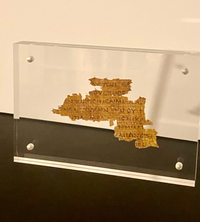
An ancient Greek translation of the Hebrew Old Testament.
An ancient Greek translation of the Hebrew Old Testament, made in stages starting around the 3rd century BC. “LXX” is simply the Roman numeral for 70, referencing a tradition that seventy scholars produced the translation. It was the Bible most familiar to Greek-speaking Jews and early Christians.
Stichometry
Counting or marking the lines of a manuscript.
The ancient practice of counting or marking the number of lines in a manuscript, historically used to calculate a scribe's pay and, incidentally, to help detect later scribal errors.
Syriac
An Aramaic dialect used as the literary language of many early eastern churches.
A dialect of Aramaic that became the literary and liturgical language of many early eastern Christian communities, preserved in manuscripts such as the Peshitta.
T
Targum
An Aramaic paraphrase or translation of Hebrew Scripture.
An Aramaic paraphrase or translation of Hebrew Scripture, produced for Jewish communities who no longer spoke Hebrew as an everyday language.
Text-Type
A family of manuscripts sharing a distinctive pattern of variants.
A family of manuscripts that share a distinctive pattern of textual variants, thought to reflect a shared line of transmission through history.
Textual Criticism
The scholarly discipline of comparing manuscript copies to reconstruct a text's original wording.
The scholarly discipline of comparing manuscript copies of a text to understand its history and reconstruct the most likely original wording. This is the field our son Noah studies as part of his research for us.
Textual Variant
Any place where manuscript copies of a text differ from one another.
Any point at which surviving manuscript copies of a text differ from one another in wording, however small — the basic unit of evidence textual critics work with.
U
Uncial
A rounded, formal style of handwriting used in Greek and Latin manuscripts.
A rounded, formal style of handwriting used in Greek and Latin manuscripts roughly between the 3rd and 9th centuries AD, distinct from the more cursive minuscule script that came later.
V
Variant Unit
A specific point of disagreement compared as a single unit across manuscripts.
A specific point in a text where two or more manuscripts diverge, treated as a single unit of comparison when scholars weigh the evidence for and against each reading.
Vellum
Fine parchment made specifically from calfskin.
A particularly fine grade of parchment made from calfskin, valued for its smooth, even writing surface and often reserved for especially important manuscripts.
Vetus Latina
The Old Latin translations of Scripture that preceded the Vulgate.
The collective name for the Old Latin translations of Scripture that circulated before Jerome's Vulgate, now surviving only in fragments and later copies.
Vorlage
The underlying source text behind a translation or copy.
The specific source text — often now lost — that a translator or scribe worked from when producing a version or copy, inferred by scholars from patterns in the resulting translation.
Vulgate
Jerome's Latin translation of the Bible, standard for over a thousand years.
Jerome's late 4th-century Latin translation of the Bible, which became the standard biblical text of the Western church for over a thousand years.
W
Western Text
A text-type known for occasional longer or shorter readings.
A text-type found in a distinctive group of early manuscripts and versions, notable for occasional longer or shorter readings not found in other text-types.
See These Terms in Context
Explore our handcrafted replicas to see many of these manuscript types, materials, and famous texts up close.
Shop Manuscript Replicas