

What’s Next
Coming Soon
A glimpse inside the workshop: manuscripts now being researched, imaged, and handcrafted for the collection.
The projects below represent only part of what is being developed as Sacred Text Replicas continues to expand its collection of biblical manuscripts.
In the Workshop
Projects in Progress
Every replica passes through four stages, from research in published scholarship and museum archives to the final handcrafted piece. Here is where each project stands today.
- 1Research
- 2Image Acquisition
- 3In Development
- 4Production
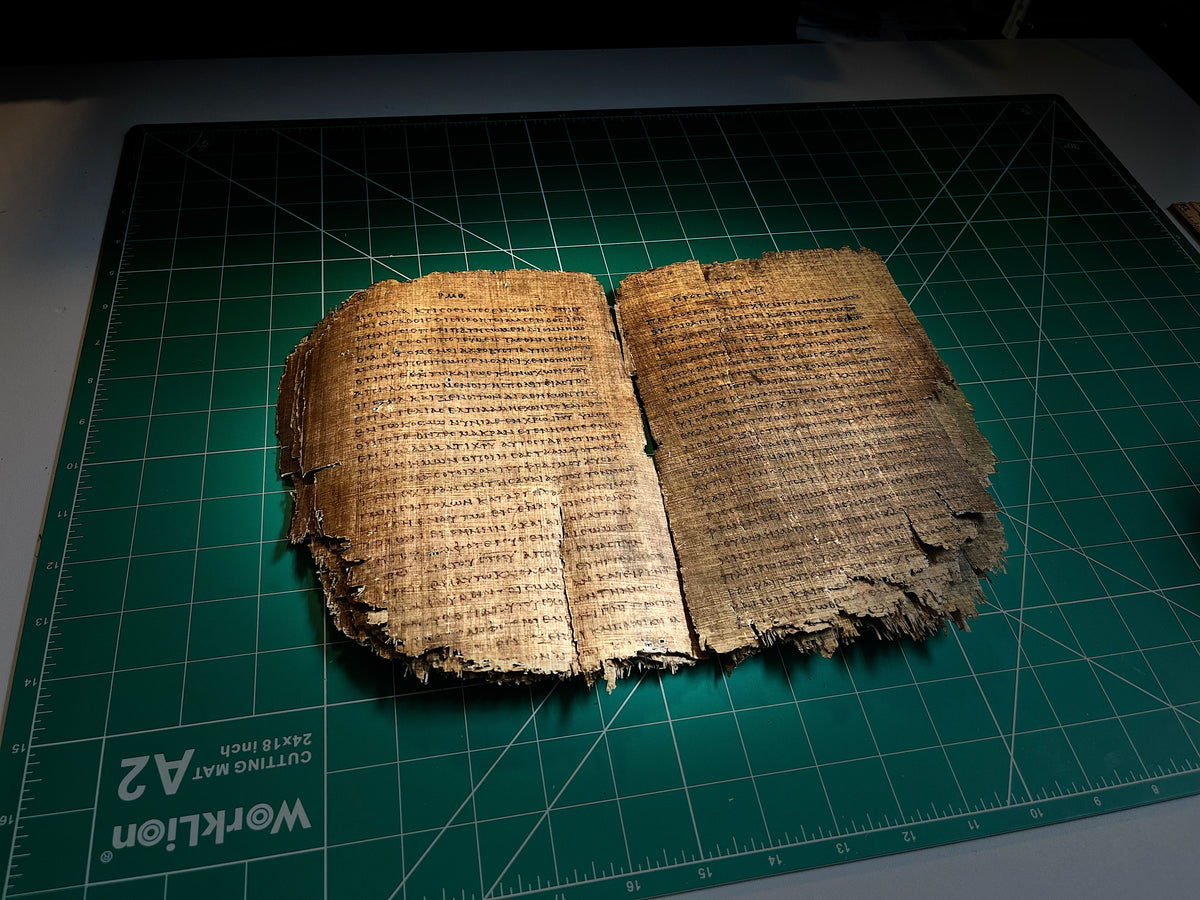
Papyrus 46 Codex Collections
In DevelopmentReconstructing early manuscripts in their original book form, beginning with the Ephesians folios of Papyrus 46.
Learn more
It is our hope, for the glory of God, to keep producing replicas of every scale, from single fragments to large historical reconstructions. Among our most ambitious goals is recreating notable ancient manuscripts in their original codex (book) form, reflecting their codicological significance and offering a glimpse into the early development of what would one day become the printed Bible.
Remarkable codices such as Codex Sinaiticus survive and are already well reproduced. Papyrus 46 is a different and far more demanding undertaking: roughly 150 years earlier than the great biblical codices, it no longer survives in its bound form, which makes any reconstruction both historically significant and deeply complex. We plan to produce individual codex sections such as Ephesians, Romans, and Hebrews, while working toward a complete reconstruction of P46 as a codex replica.
The Ephesians codex is expected this fall.

Manuscript Kits
In DevelopmentA new educational line that lets you create a manuscript replica of your own.
Learn more
Carefully designed kits for creating your own manuscript replica, made to help individuals, families, churches, classrooms, and students engage more deeply with biblical manuscripts, their history, and the craft of faithful reproduction.
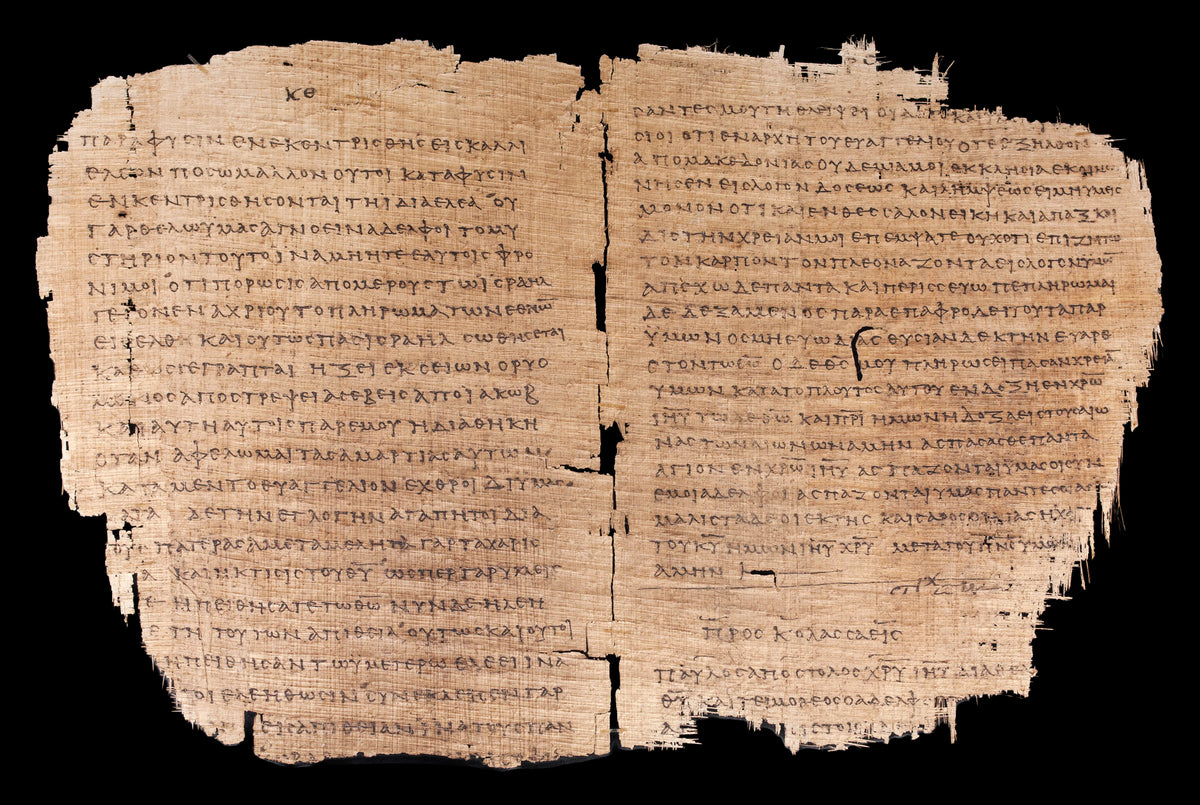
Romans Collection · Papyrus 46
In Development · Romans 8 now availableBeloved passages from Paul’s Letter to the Romans as they appear in Papyrus 46, leading toward a reconstructed Romans codex.
See Romans 8, now availableLearn more
Our Romans collection from Papyrus 46 (P46) will present some of the most beloved and theologically significant passages in all of Scripture as they appear in one of the earliest surviving New Testament manuscripts. Planned sections include Romans 5 (Peace with God Through Faith), Romans 6 (Dead to Sin, Alive in Christ), Romans 8 (Life in the Spirit), and Romans 12 (A Living Sacrifice).
By preserving the distinctive script, layout, and character of P46, the collection offers a tangible connection to the earliest Christians who treasured and copied Paul’s letter.

Papyrus 46 Tie
Coming SoonA necktie printed with a column of Papyrus 46, one of the earliest surviving copies of Paul’s letters, its Greek script and papyrus grain carried down to the frayed edge of the leaf.
Learn more
The design takes a single column from Papyrus 46 (P46), the early codex of Paul’s letters, including the opening of Ephesians 1: “even as he chose us in him before the foundation of the world.”
Made for the lecture hall, the pulpit, the office and the Lord’s Day: a quiet way to carry one of the oldest witnesses to the New Testament.
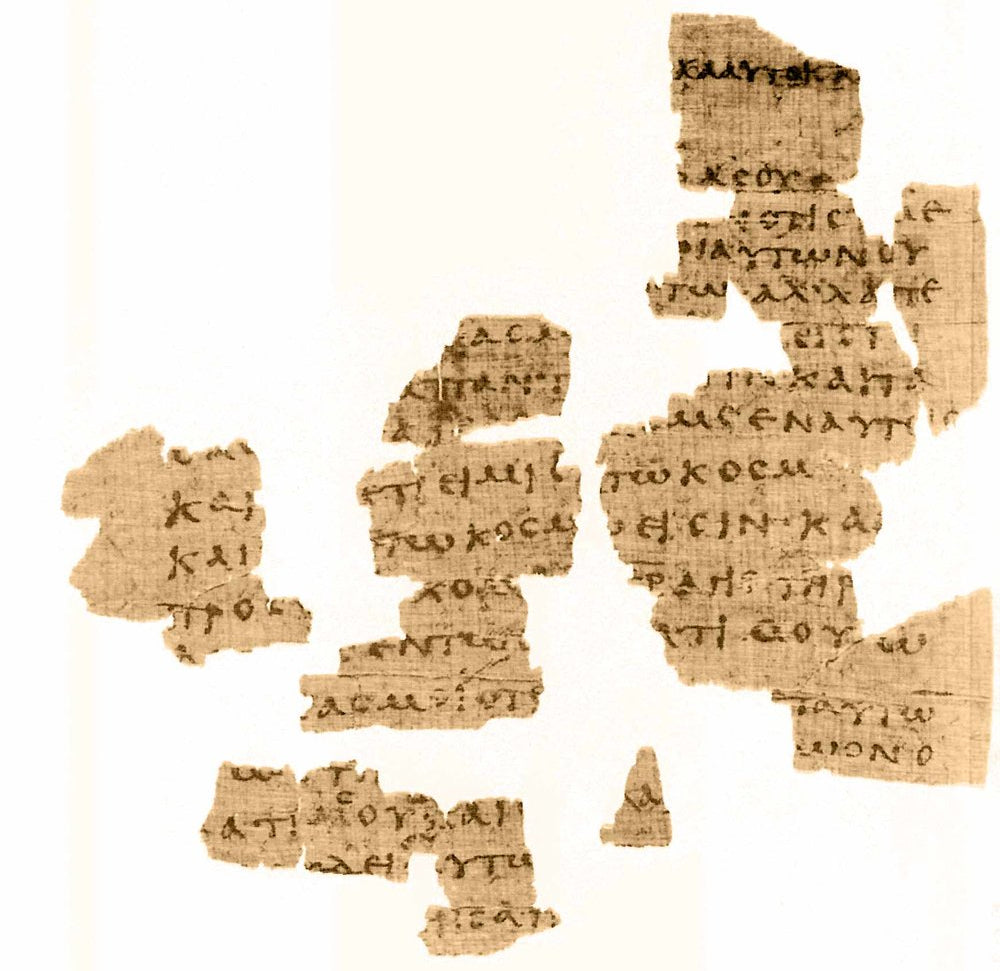
John Collection · Papyrus 66
Image AcquisitionPassages from the Gospel of John in Papyrus 66, including the High Priestly Prayer of John 17.
Learn more
John 1: “In the beginning was the Word.”
John 10: “I and the Father are one.”
John 17: the High Priestly Prayer.Further passages from John 4, 6, 11, and others are planned as part of a broader Johannine collection.
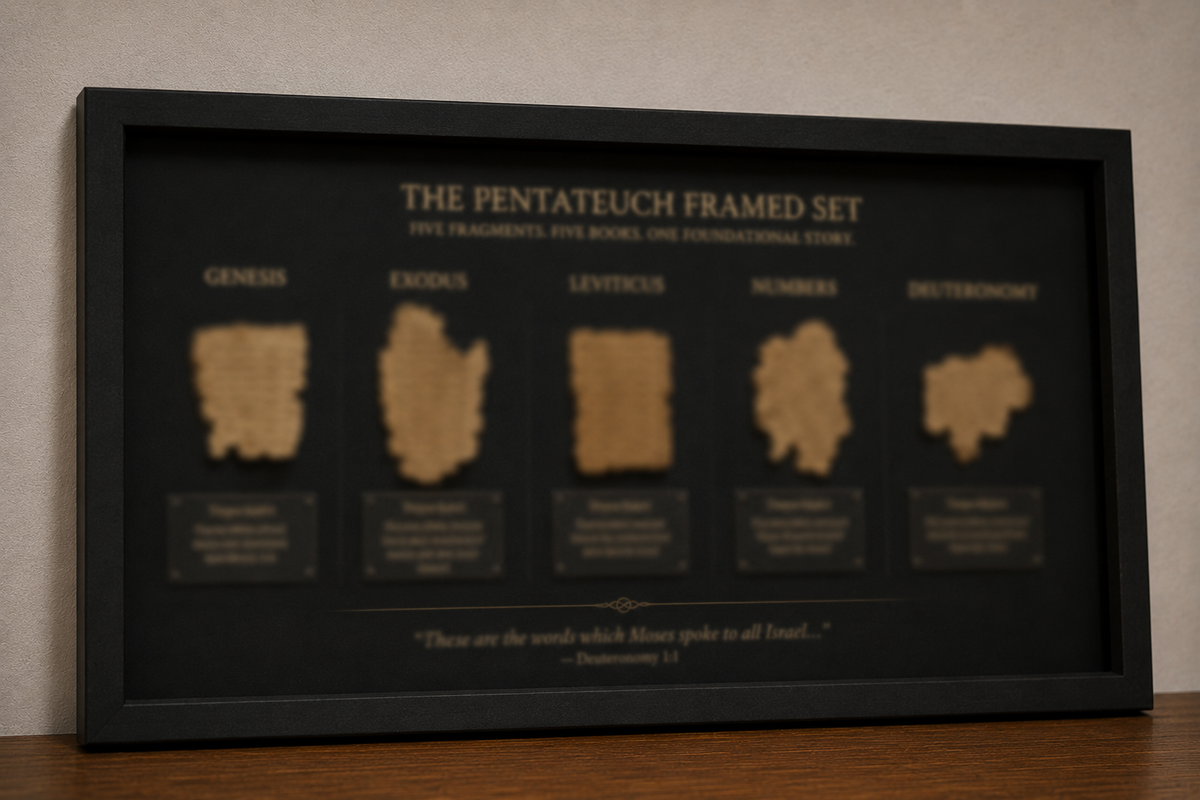
The Pentateuch Framed Set
In DevelopmentA witness to each of the five books of the Torah, Genesis through Deuteronomy, mounted together in a single frame.
Learn more
Like our Earliest Witnesses to the Gospel collection, this piece brings the five books of the Pentateuch together into one framed display: a way to hold the whole of the Torah’s opening books in one place.
Planned witnesses include the Genesis Dead Sea Scroll fragment (4Q7) for Genesis, Papyrus 18 and the Nash Papyrus for Exodus, and the Nash Papyrus for Deuteronomy. Fitting early witnesses for Leviticus and Numbers are still being researched.
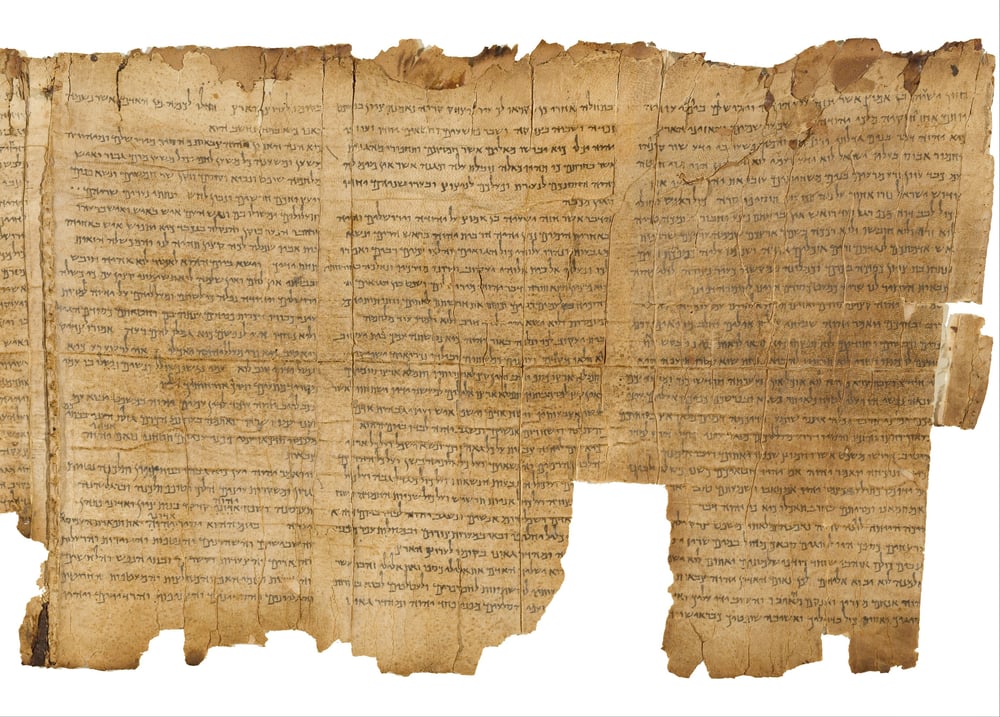
Hebrew Bible Manuscripts on Parchment
Production · First pieces availableMajor Old Testament manuscripts on parchment: a slower, more exacting craft that must account for the variation, translucency, and stretch of skin.
Browse the Old Testament collectionLearn more
These projects include piece reconstructions of notable texts from the Dead Sea Scrolls and other early manuscript traditions preserved on parchment. Parchment presents very different artistic and technical challenges from papyrus, requiring far more time, fidelity, and material preparation to reproduce faithfully.
Planned: the Habakkuk Commentary (1QpHab) · portions of the Great Isaiah Scroll (1QIsaᵃ) · Septuagint traditions · the Minor Prophets Scroll.

KH2 silver scroll, Ketef Hinnom · Wikimedia Commons, public domain The Ketef Hinnom Silver Scrolls
ResearchTwo tiny inscribed silver scrolls from a Jerusalem family tomb, carrying the Priestly Blessing of Numbers 6: the earliest known citations of texts found in the Hebrew Bible.
Learn more
In 1979, during Gabriel Barkay’s excavations at Ketef Hinnom, just outside the Old City of Jerusalem, two tiny inscribed silver plaques were recovered from the repository of Burial Chamber 25 in Cave 24, a family tomb whose burial chambers branch off a central hall. Rolled tightly when found, they are known today as Ketef Hinnom I and II. The larger measures only 27 × 97 mm; the smaller just 11 × 39 mm.
Both preserve the Priestly Blessing of Numbers 6:24–26: “May YHWH bless you and keep you; may YHWH make his face shine…” Ketef Hinnom I also speaks of the God who keeps “the covenant and graciousness toward those who love him,” and calls YHWH “our restorer and rock.” Worn as protective amulets, they are the earliest known citations of texts also found in the Hebrew Bible.
A 2004 re-edition based on new high-resolution imaging by West Semitic Research reaffirmed a date at the end of the seventh century BC, in the final decades before the Babylonian destruction of Jerusalem. The scrolls are kept today in the Israel Museum, Jerusalem.
Our replica project is now in research, with release planned for spring 2027.
Source: G. Barkay, A. G. Vaughn, M. J. Lundberg, and B. Zuckerman, “The Amulets from Ketef Hinnom: A New Edition and Evaluation,” Bulletin of the American Schools of Oriental Research 334 (2004): 41–71.


The Collection Continues to Grow
As new manuscripts are researched, restored, and handcrafted, this page will continue to grow with future releases and educational projects. Sign up below for release announcements, follow along on social media, or browse what is already available.